The Power of Stories to Build Peace. Member Spotlight: Kit Hadlund
Day-to-day, Kit Hadlund, a poet, drummer, dancer, and peacebuilder, wakes up a little after 5am to get his kids to school and have his coffee before shifting his heart towards his work. Since 2022, he’s privately consulted for nonprofits, corporations, communities, individuals, and other schools through his startup, Heartroot Collective. Though he defines his role as that of a peacebuilder, Kit more aptly characterizes himself as a story-gatherer and translator. This philosophy lies at the heart of his calling.
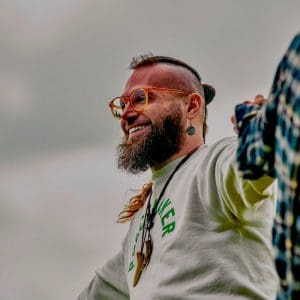 Kit’s own story starts as a child. When he was young he “experienced internal conflict within my family system,” in particular separation, abuse, and neurodivergence. These direct experiences guided him towards the richness of his own and others personal stories “as a way to express myself freely.” He attended DePaul University in Chicago, studying International Studies and African and Black Diasporic Studies, and co-founded Depaul’s first slam poetry team. Interacting with the impact of his story and those of others, he said “No two people experience life in the same way. How can I more deeply understand others by more deeply understanding myself?”
Through this philosophy, Kit has been able to “transform a lot of this childhood pain into being an example for my two sons,” which also allowed him to confront identity, gender, power, and class in unique ways. This is why he particularly enjoys facilitating conflicts where individuals or communities grapple with cross intersectional, identity-based boundaries such as class, race, age, or background.
After graduating from DePaul, Kit began his career leading peacebuilding circles in Chicago Public Schools as part of a governmental grant to reduce violence in high-impact schools. Working as a 15-person team of restorative justice practitioners, his job was “ stop the school-prison pipeline,” that insidious system of power that punishes instead of supports the highest-need students. The job was gritty, strategic, and explorative. He also got trained, cajoled and mentored from the perspective that Community Peacebuilding is an Indigenous Way of Life. His mentors are Sandra Sosa, Tomis Ramirez, Shedrick Sanders, and Jonathen Peck, and others. Kit states. “If you really want to understand conflict, all you have to do is watch a river run roughshod over rocks, OR look at what the sun does to your skin on a hot day, OR what wind does to homes.” In this way for Kit, Conflict is simply a way of life.
As Kit experienced school culture first-hand, he got this message from students, “We’re going to be alright as long as you adults can get your stuff together.” That’s the push Kit needed to reach the next level within his work. From that point on, Kit became highly attuned, challenging adult mindsets around power, control, community, and hierarchy. In particular, he remarked that the hierarchical, punitive-based structure and culture of educational institutions made up by adults often lack a healing-centered philosophy, reproducing models of power and control instead of transforming them.
Kit’s over-all approach centers on “analyzing mechanisms of power to make visible what’s invisible.” Returning to the idea of storytelling, holding a space that invites participants to share their stories and what is impacting their lives is the key part of how restorative justice circles connect participants together. For each session he consults/mediates, he arranges all participants to sit equidistantly from each other in a circle, signifying that all participants are equal and that there is no barrier to connection. He usually places objects into his circles that ritually symbolize the four life-creating elements: earth, wind, fire, and water. He also uses other symbolic representations, like a child’s toy to represent the child in us all, inspirational quotes, and a talking piece/object to guide conversation’s flow.
When asked about the impact of his work, Hadlund had a lot to share. His work has ranged the gamut across age, race, gender, and setting. All spaces he creates have the same values, that “We are all stitched together in this undeniable fabric we call life. We may look different, feel different, love different, yet we may not be so different after-all.” Hadlund believes that “circles meet participants’ unfulfilled needs of being seen, heard, and valued and give people skills to know themselves better,” He has guided countless individuals through transformative processes, and then gotten to know himself even better. In this way he states “Restorative Processes are a constant dialogue between facilitator and participant. There are no same two ways a process will end”
Hadlund’s own story is inspiring. As Co-Founder of the Heartroot Collective, he has led healing circles for parolees, serves as an International Menswork Facilitator, provided safety for survivors of sexual violence, served as the Sierra Club’s Conflict Transformation Strategic Advisor for over a year during COVID, and regularly partners with nonprofits like the Karuna Center for Peacebuilding, and Dogwood Alliance to provide trainings in Generative Conflict, nonviolent communication, and mediation. He said that although peacebuilding is a career, “this isn’t just work, it’s not just an approach, it’s not just a practice, it’s life – in all of its animate, raw, vulnerable ways” Kit thanks his Ancestors for this calling, and looks forward to walking his path in a most humble way.
Article by Hunter Siegel, MBBI Writer