Building Bridges in a Divided World: A Journey Through Mediation and Peacebuilding. Member Spotlight: Mia Jeandonnet-Richard
Mia Jeandonnet-Richard’s path into peacebuilding did not begin with a dramatic turning point but with a gradual unfolding. A series of small impulses that eventually revealed a clear direction. Growing up in Montreal, she felt an early pull toward humanitarian work and what she describes as “political social work.” Even before she understood the vocabulary of peacebuilding, she carried an instinct for fairness, dialogue, and community care. It wasn’t until she entered Sherbrooke University to study Political Science and International Relations that these ideas began to take shape.
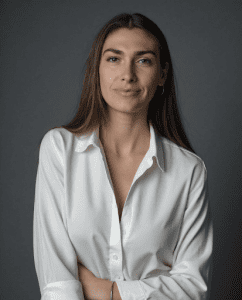 At Sherbrooke, Mia discovered negotiation and dispute resolution. These were not abstract theories, but flexible frameworks capable of embracing the complexity of human conflict. Negotiation, she explains, offered “a structure you can easily muddle into your needs,” a tool that makes it possible to navigate conflict rather than avoid it, and one that can also enhance collaboration, even in the absence of conflict. After an experience as a political attaché, she pursued a master’s degree in conflict prevention and dispute resolution, seeking to move away from power-based negotiation dynamics and to promote more collaborative approaches. This journey unfolded alongside the onset of the COVID-19 pandemic and a period of global uncertainty. That time reinforced her conviction that conflict resolution was not merely an academic interest, but an urgent necessity.
Her understanding deepened outside the classroom. During covid , in Montreal, Mia established a community mediation program that facilitated dialogue between homeless individuals, social workers, and police officers. The workshops eventually reached more than 3,000 people, but the real transformation happened in the room: officers and unhoused residents—groups often placed in opposition—began to see one another as human. Participants who rarely felt heard started sharing their stories. “I didn’t know how far negotiation could go,” Mia reflects. “I didn’t know how well it could work.” What began as a community mediation program became a powerful act of dignity-building.
Her experience within Quebec’s Ombudsman program under the Student Advocate (Protecteur de l’élève) revealed similar dynamics. By supporting children and families through institutional disputes, she observed how principled negotiation and mediation could uplift marginalized voices, restore trust, and foster understanding, even in the absence of a perfect agreement. At every level whether that was street, campus, or community. Mia saw that mediation was ultimately about empowerment.
After her first master’s, Mia moved to France to complete a second degree in mediation. Her work there expanded her awareness of cultural contexts, demonstrating how deeply conflict resolution is shaped by history, communication styles, and social norms. Her experiences in Canada, France, and parts of Asia reinforced her belief that mediation requires humility. “The main thing we need in mediation is understanding culture,” she insists. Entering a conflict without curiosity and assuming one’s methods are universal; is, in her view, a mistake that can undo the entire process.
But peacebuilding today faces rising obstacles. Mia has witnessed a global shift away from collaboration toward hardened hierarchies and deepening inequality. Addressing power imbalances has always been challenging, but in the current climate, it is increasingly difficult. For her, the starting point is simple but courageous: name the inequality. Acknowledge who holds power and who feels unsafe. Ethical processes begin with honest language.
Her reflections extend into the digital sphere as well. Social media, she notes, accelerates polarization while simultaneously mobilizing social change. Many platforms young people use today are poorly designed for meaningful dialogue. With proper moderation and value-driven leadership, social media could strengthen community however without it, division spreads quickly.
Mia’s approach to mediation is rooted in humility and self-awareness. “We need to know ourselves very well,” she says. Peacebuilding demands the ability to set aside one’s internal activist and approach conflict with a commitment to listen rather than win. She applies non-violent leadership in her work, especially as a young woman in a field still dominated by older male voices. For her, leadership is less about authority and more about example: living the politics of cooperation rather than merely teaching them.
She is also sensitive to the burden carried by marginalized individuals, who are often expected to speak not only for themselves but for an entire community. Mia recognizes both the weight and the opportunity this creates, the power to shift narratives and humanize experiences that institutions often overlook.
For Mia, mediation is inherently political. Not because it takes sides, but because it creates space for representation. In an era where collaboration is sometimes framed as weakness, mediation remains a courageous act. It fosters honesty, relationship repair, and solutions that adversarial systems like courts or arbitration cannot achieve. “When we are true to ourselves, we’re not reacting—we’re collaborating,” she says. “We’re dancing with the world.”
Despite the challenges facing global peacebuilding, Mia finds hope in small initiatives. Local mediation projects, culturally rooted practices, and grassroots partnerships often generate the trust and dignity that large institutions struggle to achieve. This is why she is deeply committed to MBB. By amplifying and connecting local initiatives, MBB advances mediation not merely as agreement-seeking, but as a transformative social experience, one that creates safe spaces for authentic dialogue, mutual recognition, and the rebuilding of trust. Even in disagreement, choosing dialogue becomes an act of reconciliation, growth, and peacebuilding at a human scale. She also often returns to the Montreal homeless project, where police officers and community members fundamentally changed how they viewed one another. “Seek the person, not the problem,” she emphasizes. A principle she sees as the heart of transformative peacebuilding.
If she could change one thing about global approaches to conflict resolution, it would be to strengthen the bridge between politics and community. Peace cannot be imposed from above; it must be rooted in local realities. Too often, peacebuilding becomes overly intellectualized and inaccessible. Mia believes sustainable change requires grounding political strategies in community needs, making peacebuilding something everyone can participate in.
Looking ahead, Mia is exploring consulting opportunities in dispute resolution, peacebuilding, and safeguarding vulnerable groups. She envisions her future at the intersection of community mediation and humanitarian law. Her long-term goal remains clear: to keep building bridges. Between individuals, between groups, or between politics and community, so that peace becomes a shared practice rather than a distant aspiration.
In the end, Mia’s story is one of ongoing transformation. It is the story of someone who believes deeply in human connection, who has seen the dignity that emerges when people are given space to speak, and who continues to trust that even in fragmented times, peace is possible when we choose to build it together.
Article by Shamailah Islam, MBBI Writer