
Finding the Middle Ground. Member Spotlight: Dr. David Shimoni
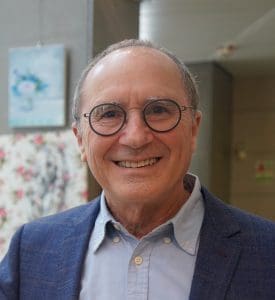
David Shimoni speaks about mediation with affection, patience, and a deep belief in its power to change lives. Stationed in Tel Aviv, he is a father of three and a grandfather of six, and for many years he has worked at the heart of conflict, helping people find understanding where communication has broken down. Before mediation became his life’s work, David’s career was rooted in education. He served as a high school principal, a role that required constant decision making, authority, and structure. Looking back, he reflects on how different his approach might have been if mediation had entered his life earlier. “I would’ve been better at everything if I did the mediation program,” he says. “To acquire these abilities, mediation skills, it changes how you see people.”
 His path into mediation began with a friend. That friend was among the first mediators in Israel and encouraged David to enroll in a mediation course. At the time, David was skeptical. His background as a school principal had trained him to decide, not to facilitate dialogue. Still, he agreed to take a basic course. That decision became a turning point. “The course opened my eyes on finding the middle ground,” he recalls. “I slowly understood the magic of empowerment and mediation.”
After completing the basic training, David continued with advanced mediation studies in Israel. What began as curiosity turned into commitment. He started mediating extensively in commercial disputes, community conflicts, and family matters, including marriage mediation. Over time, he built a strong portfolio and a reputation as someone deeply invested in the process and its outcomes.
In 2012, David took another major step by establishing one of Israel’s three recognized mediation centers. The center became authorized by the Israeli Ministry of Justice to run official mediator training courses. Through this work, he helped train generations of mediators, many of whom now work within the court system. His involvement expanded beyond practice and training into advocacy. David eventually served as chairman of the organization of mediators in Israel, where he became involved in the politics of mediation and initiated efforts to legislate and regulate the field nationally, a goal that has yet to be fully realized.
Alongside his mediation work, David entered academia. For many years he has been a university professor, now teaching in a graduate program focused on conflict resolution. His teaching centers largely on culture and dispute mediation, reflecting his belief that conflict cannot be separated from the social and cultural contexts in which it exists.
Today, David describes his peacebuilding work as both practical and deeply human. One of the major challenges he identifies in Israel is the lack of Arabic speaking mediators, despite the fact that around 20 percent of Israeli citizens are Arab. In response, he helped assemble a team of Arab and Jewish students in the city of Acre, where he co-teaches an official Ministry of Justice mediation course. The program works in collaboration with small claims courts, allowing trainees to handle real cases under supervision. “Within about two hours there is a solution,” David explains. “It gets sent to the judge for approval.”
He is clear about why mediation matters. Compared to court proceedings, mediation saves time and money and often preserves something far more valuable. “When a judge makes a decision, that’s the end of the relationship” he says. “In mediation there is a continuous relationship.” For David, success in mediation is measured not only by agreements but by trust. “Mending relationships,” he explains. “There is a building of trust between parties.”
David believes mediation allows people to think, reflect, and recognize their own part in a conflict. He describes the court process as rigid and formal, while mediation is flexible and personal. “Mediation is more satisfactory for people involved,” he says. In Israel, he points to community courts as an example of restorative justice in action. In these courts, offenders meet not only judges but also social workers and volunteers, creating space for accountability alongside support and alternative solutions.
The work is not without challenges. In court annexed mediations, lawyers can sometimes undermine the process, especially when they are paid by the hour and see less incentive in quick resolutions. Cultural dynamics also play a significant role. Israel is a country of immigrants, and many people arrive without fully understanding the social norms of their new environment. “We need to understand where people are coming from,” David says. His approach blends facilitative mediation with careful explanation and reflection, always adjusting to cultural needs. He often co-mediates with a female colleague, believing that a mixed team creates a more balanced and less intimidating atmosphere.
Building trust, he says, takes time. “Slowly, surely,” he explains. Reflection is key. “I always tell them, they don’t have to be in this room if they don’t want to.” Giving people choice, he believes, helps establish safety and respect, which then sets the tempo for meaningful dialogue.
Over the years, David’s perspective on peace has deepened. He struggles to accept the idea that war can lead to a better quality of life. “The horrors of war, and wounded people, it doesn’t make sense,” he says. He points to historical examples, like France and Germany, countries that fought for centuries before realizing cooperation was the only path forward. For him, Israel’s mixed cities, where Jews and Arabs live side by side, hold particular importance. “We all share similar problems,” he says. “If we manage to repair relationships between mixed cities, we can send a message.”
What gives him hope is the number of people who still believe in peace. “There’s a mass of people who believe in it,” David says. Across societies, he sees movements and individuals committed to dialogue and reconciliation. “War does not make sense, both parties suffer.”
As for what comes next, David’s answer is simple. He enjoys his work and intends to continue mediating and teaching. He wants to keep assisting in peacebuilding efforts, particularly in his region, and remains committed to passing on the skills and values that first transformed his own life. For David mediation is not just a profession. It is a way of seeing the world and a belief that repairing relationships is the foundation of lasting peace.
Article by Shamailah Islam, MBBI Writer