Sierra Leone

The Sierra Leone project provides in-depth and long-term support to leaders in Sierra Leone who become:
- Skilled in conflict resolution and prevention
- Empowered to take active roles in sustaining peace and building societal resilience
- Actively-engaged in Sierra Leone’s ongoing development
The Republic of Sierra Leone has been tested by events over the past three decades: A Civil War from 1991-2002, fueled by a desire to control the country's diamond mines and resulting in over 129,000 deaths; the Ebola epidemic from 2014-2016; the 2017 mudslides in Freetown, which damaged or destroyed hundreds of buildings, killed 1,141 people and left more than 3,000 homeless; followed by
COVID-19 and now the rapidly growing Kush pandemic. However, the love and dedication that the people in Sierra Leone have for their country have impressed and inspired members of MBBI. The Sierra Leone team has kept up a fifteen-year partnership working with civil society leaders to build sustainable peace - the longest-running MBBI capacity-building country project.
Next Steps
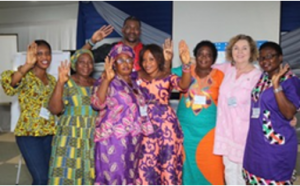 In 2026, Mediators Beyond Borders International (MBBI) will be working with local partners on a national conference in Sierra Leone to address the country’s rapidly growing Kush drug epidemic. Our Sierra Leone contacts and in-country partners have repeatedly identified this crisis as the most critical issue they are facing. This crisis is devastating youth and communities, exacerbating crime, violence, instability, unemployment and poverty. By gathering 75 cross-sector leaders through a Future Search Conference model, this initiative will catalyze shared action, coordination, and a vision for healing and peaceful youth-centered solutions.
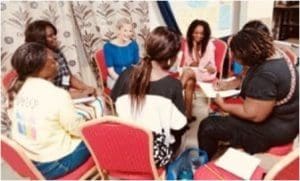
The skills and perspective that MBBI has been committed to developing in its work in Sierra Leone is the willingness/ability to have and facilitate these kinds of difficult conversations/dialogues that are about addressing issues within the country. Along with alumnae of its programs, the Sierra Leone team will facilitate these discussions and model how these conversations can happen, how to talk together, how to develop ideas and action plans together, and how to work together.
Team Leader: Maureen Inglis, Australia
If you are interested in the work of this project please contact Maureen Inglis at minglis@esc.net.au.
 Members:
- Loretta Raider, USA
- Alpha Umarr Barrie, USA & Sierra Leone
- Amhed Kamara, USA & Sierra Leone
- Klubosumo Johnson Borh, USA & Liberia
- Elika Dadsetan, USA
- Sunita Kumar, USA
Partners:
- Bo Rotary Club District 9101
- Magnolia Texas Rotary Club District 5910
- WIL of Greater Philadelphia
- Susan Conteh, Campaign for Good Governance
- Ebu Daramy, USYDA
- Hannah Yambasu, WAVES (Women Against Violence and Exploitation in Society)
- Mohamed Sheriff Mansaray, Kono District Council
- Mohamed Shonnah, Moawoma Rural Women’s Cocoa Development Co-operative Society
- Elizabeth Breweh, Good Deeds for Sierra Leone
- Badriatu Turey, National Election Watch Sierra Leone
Project History
In 2009, local Sierra Leoneans asked MBBI for assistance in resolving conflict following violence at a university in Freetown. After conducting a thorough needs assessment a series of trainings were conducted for students and faculty.
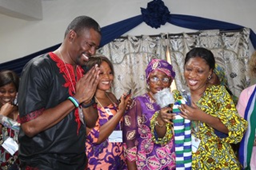 While conducting workshops in Sierra Leone on mediation and negotiation to bring about peaceful elections in 2012, the project team asked participants what were their most pressing future needs for training and development. From focus group sessions in October 2012 and a follow-up survey/discussion in May, 2013, the following four priorities were established for the Sierra Leone Project: 1) Women Empowerment Training to develop/strengthen future women political leaders in Sierra Leone to reach the 30% UN goal; 2) Community Leader Train the Trainer Workshops in Negotiation and Mediation; 3) Youth Leadership Training; and 4) Tribal Leader Workshops to help solve community issues/conflicts.
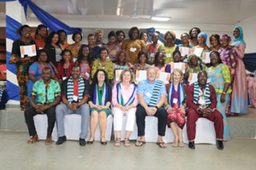 During the wide-spread Ebola epidemic in 2014, when travel to the country could no longer occur safely, the Project Team developed an online Training of Trainers (TOT) Workshop for Community Leaders and training for community leaders dealing with trauma in order to address the most pressing needs of the community created by the Ebola crisis. The team consistently communicated with community partners in Sierra Leone through e-mails, teleconferencing and Skype. For more information on this part of the team’s work, see “Cross-Cultural Mediation, Peace and Conflict Resolution,” published in Africa: A Reader. Cambridge Scholars Publishing Ltd, April 2018.
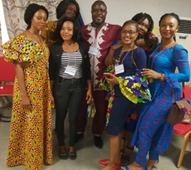 In February 2018, the Team held four workshops on Building Unity for Peaceful Elections and trained over 300 participants from diverse stakeholder groups. These workshops were co-facilitated with community leaders, graduates of our Training of Trainers program. In collaboration with local partners, the MBBI Team conducted needs assessment interviews and focus groups with corporate CEO’s, UNDP, women and youth leaders, as well as youth and women’s groups. Data collected overwhelmingly highlighted the challenges faced by both women and youth in society and the need for building the capacity of women and youth leaders.
This led to the training, coaching, and community projects that are occurred in 2020 and beyond.
In January 2020, the next step of the work began when six team members spent two weeks in Sierra Leone conducting two training sessions, one week with women leaders and the other with youth leaders. Over 300 people applied for the 60 seats. The goal is to support sustainable peace in Sierra Leone through Leadership Development and Conflict Transformation.
During the initial training, Leadership Learning groups were created with the participants. These monthly peer groups, each facilitated by one of the trainers, are using a support challenge model of coaching as the participants work to develop and implement their community projects.
2023 saw the return of team members in-country to conduct two more workshops on Building Unity for Peaceful Elections, once again with the support of alumni to assist in the facilitation and evaluation of these programs.
Dialogue and Conflict Transformation Skills Workshops were held in Waterloo (Western Rural Freetown) and Port Loko (North-West Region). The workshops trained 110 participants—including women, youth, chiefs, political leaders, security personnel, media, and religious leaders—as Peace Ambassadors to promote tolerance, non-violence, and peaceful elections.
A follow-up survey assessed participants’ knowledge gained, skills developed, and application of learning in personal, organizational, and community contexts.
The program reduced violence and fostered tolerance during Sierra Leone’s 2023 elections. Sustaining peacebuilding progress will require:
- Continued training and mentorship of Peace Ambassadors,
- Ongoing community engagement, and
- Institutional integration of conflict transformation practices.