
How One Peacemaker is Building a Better Future for All. Member Spotlight: Sahlim Charles
“A child at one of our partner schools was violent, fighting the other kids and generally causing trouble. But after going through eight months of our training and mentorship, the school reported a shift not only in the student’s behavior, but also in the emergence of a young peacebuilder. This student, together with others, went through lessons and games on the importance of mediation and solving conflicts in a peaceful way. Before long, the once-troubled child was a peacemaker himself.”

Sahlim Charles has witnessed countless transformations of this kind during his work as a grassroots organizer, Peacebuilder communicator, and children’s advocate in Kenya.
Sahlim first got involved in community work during high school, where he was a student leader. He had the opportunity to participate in an international intercultural and leadership exchange program in Sweden; there, he got to learn about and understand the importance of global citizenship. He was inspired by what he saw in Sweden and began thinking about creative ways to solve problems in his own community.
Sahlim is now the executive director of Re-Imagining New Communities, a non-profit and values-driven peacebuilding organization that works across Kenya to understand local problems and find community-led solutions. The organization’s actions are guided by the unique needs of each community—no two are the same. Sahlim has built an expert team of mentors, facilitators, and peacebuilders. Re-Imagining New Communities has had a presence in six counties, 55 schools, and 35 Churches across Kenya.
Through their flagship program, Children-Led Community Peace Labs, kids are taught the motto, “Don’t pass by when you see conflict.” For example, if a child sees people arguing in the local market, they should listen and look for an opportunity to impart peace into the situation. With these skills, children have even brought peacebuilding home to the adults in their lives. The level of maturity possible in these children is impressive, and underscores one of the main themes driving Sahlim’s work.
“What inspired me to start working with children is the untapped potential of the younger generation. Most of the time, when we talk about peacebuilding, we view children as passive participants left out of the conversation. Their wisdom is not recognized.”
 Sahlim is adamant about young people being at the center of peace processes, while at the same time acknowledging the unique challenges of working with children. At every level of a community, adults make the decisions concerning the lives of young people. This, as Sahlim explains, is an unsustainable model for a peaceful future. Young people must be seen as more than just recipients. There must be representation of and power-sharing with young people regarding peacebuilding—especially at the United Nations. “The future,” Sahlim says, “depends on how effectively we incorporate young people into peace processes.”
But children also require more support during their development—and especially from adult role models. Sahlim leads by example in creating safe spaces for young people. Many of them have been through traumatic experiences, and so, for Sahlim, protection and inclusivity are the two most important things when working with young people. In Sahlim’s workshops and programs, everyone’s experience is valued. Even the smallest detail of a child’s story may be the key to better understanding their perspective and figuring out how to best support them. Indeed, as Sahlim remarks, “Adults who perpetuate violence were once children.”
Sahlim is also passionate about better incorporating faith communities into the United Nations. 75.8% of the world’s population identifies with a religious group, making faith an requisite factor in peace processes. Faith traditions and culture greatly influence community decisions, and this reaches across local, regional, and international sectors. Sahlim is a Co-Lead of Faith-Based Solutions for a UN Impact Coalition in which he works to build trust with faith leaders. Faith is a moral and ethical anchor for many, and thus should not be separated from peacebuilding at large.
“Some of the faith traditions contribute directly or indirectly to conflicts in the community. And so if we build people’s capacity within faith communities, then we are able to better support them and prevent violence at the grassroots level.”
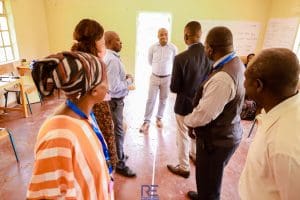
 Sahlim works with faith communities in Kenya to facilitate peacebuilding dialogue. Faith indeed holds great power and influence in local communities, but the leadership hierarchy often lacks the training needed to solve deeper issues. Re-Imagining New Communities helps Churches effectively re-organize their leadership in order to better support their congregations and the wider community.
Grassroot organizations like Sahlim’s must prioritize collaboration and inclusive communication for their continued success. Sahlim notes that we all have inherent personal bias, but the more we push for diverse voices and perspectives, the better. Progress depends on having a flexible, non-judgemental, and extremely creative mind, as Sahlim has found.
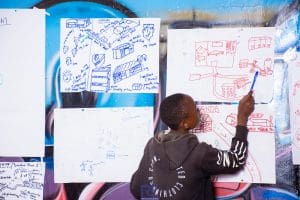
Art plays a large role in Sahlim’s work. He regularly incorporates a multitude of artistic approaches in his programs and advocacy. For example, a group of kids will often not fully open up about their problems until alternative ways of communication are introduced. Imaginative storytelling and painting have resulted in substantial progress being made. Sahlim enjoys integrating art into peacebuilding. His widely-celebrated report on Youth-Led Peacebuilding in Kenya has an accompanying documentary film. For as Sahlim says, “Someone else will tell your story if you don’t.”
Art isn’t judgemental like words and body language can be. Sahlim explains that art speaks directly to our emotions, better confronting trauma and providing varying avenues for acceptance and even breakthroughs. Sahlim doesn’t underestimate the role of positive, optimistic art forms in everyday society. Growing up, he too often saw negative, depressing media in his community. Countering violence and despair with peace and joy through art sends a powerful message to the future generation.
What’s more, Re-Imagining New Communities has an impressive, tight-knit alumni network. Many children who were once taught by the organization are now mentors themselves, and volunteers have gone on to hold leadership positions. “People are growing up with us,” Sahlim says. This ballooning effect will help to secure the organization’s future, but nothing is for certain.
Sahlim expresses the mixture of fear and excitement that comes with running a non-profit. He has created an organization that is bigger than himself, but which now requires a plan for future resilience. Nevertheless, there is distinct pride and determination in Sahlim’s voice as he declares, “If I’m not there tomorrow, this work will still go on.”
Article by Elsie Aleck, MBBI Writer