
Environmental Peacebuilding and the Power of Belonging. Member Spotlight: Caroline Walsh
Caroline Walsh’s earliest memories of the world are shaped by movement, water, and difference. Born in South Africa at the end of apartheid, she enters life in a place defined by division and transition, even if she does not yet have the language to describe it. Later, in Cyprus, that awareness begins to take form. “It was my first experience of a divided island,” she reflects, a moment that quietly teaches her “not to take things at face value.”
By the time she is fourteen, she is underwater.
Scuba diving in Cyprus has become more than a hobby. It becomes a way of seeing. Suspended between worlds, she begins to understand ecosystems not just as environments, but as fragile networks of interdependence. Her love of swimming, her curiosity about nature, and her early exposure to different cultures start to converge. What begins as fascination soon grows into purpose.
“I got into environmental science and conservation through scuba diving,” she explains, tracing a path that leads her toward coral reefs and the communities connected to them. But even in those early years, her attention is not limited to the natural world alone. She notices something else unfolding beneath the surface. “Environmental things have always had an element of conflict resolution in it,” she says. Questions of access, resources, and responsibility are never neutral. They are shaped by people, by politics, and by power.
At sixteen, that realization deepens when she travels to Jordan. There, she becomes involved in peacebuilding work with divers from both Jordan and Israel. The setting is specific, but the lesson is lasting. Cooperation is possible, even in contexts marked by tension. Shared spaces, like the ocean, demand it.
Her academic path reflects this growing complexity. Over time, she completes multiple master’s degrees, each one adding a layer to her understanding of how environmental issues intersect with human behavior and political systems. Her second masters’s focuses directly on this connection. Her thesis examines environmental behavior among scuba divers, exploring how individual choices ripple outward into broader ecological and social systems. “It can be a political choice sometimes what resources get deployed, and how it impacts people in their everyday lives,” she says. The work reinforces what she has already begun to see. Politics, mediation, and peacebuilding are “all very heavily interlinked.”
But Caroline’s journey is not confined to theory.
She describes her path into peacebuilding as something that “wasn’t linear.” It unfolds gradually, shaped by lived experience as much as by formal study. In the early 1990s, she was already volunteering in marine conservation and citizen science, moving between places like Cyprus and Jordan. Even then, she finds herself drawn to the human dynamics within those spaces. “I was drawn not just to environmental issues, but to what happened between people,” she says. Cooperation, tension, trust. These become the threads she follows.
Over time, that focus evolves into a deeper engagement with conflict itself. Through restorative practice, particularly in youth justice and school settings, she begins to see how structured dialogue can shift even the most entrenched positions. “When people are given the right conditions, safety, structure, and genuine listening, their positions soften,” she explains. What emerges in those moments is not agreement, but something more fundamental. Recognition. Humanity.
That insight becomes central to her approach. “Peacebuilding isn’t about changing minds,” she says. “It’s about changing the quality of interaction.”
Today, her work sits at the intersection of dialogue design, mediation, and restorative practice. Through her organization, Sage Resolution, she develops processes that help communities and organizations navigate conflict more constructively. There is no single “typical” day. One morning might involve designing a workshop. Another might be spent facilitating a difficult conversation or reflecting on how a previous dialogue unfolded. Reflection, she emphasizes, is not an afterthought. “I treat it as part of the methodology, not an add-on.”
Her definition of peace reflects this same depth. It is not the absence of conflict, but the ability to remain in a relationship through it. “Peace is the capacity to navigate disagreement without breakdown,” she says. It is also closely tied to belonging. “Where people feel they belong, they are more able to engage constructively, even in difficult conversations.”
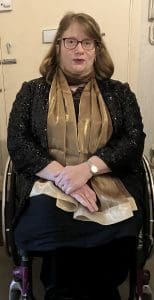
That idea of belonging is not abstract for Caroline. As a disabled practitioner, she is acutely aware of how inclusion shapes participation. Success in peacebuilding, for her, is not measured only by outcomes, but by experience. “Feeling like you belong in a project,” she says, is essential. It is about “inclusion, being and leading in something,” and about “when people think outside the box to help me feel included.”
In environmental peacebuilding specifically, success often looks like accessibility. It looks like stakeholders creating systems that allow more people to engage meaningfully with shared challenges. It also requires creativity. “When people think outside the box,” she notes, it opens up possibilities that rigid structures often overlook.
Despite the challenges of polarization, limited resources, and the slow pace of change, Caroline remains grounded in a quiet optimism. What gives her hope is not a single breakthrough or large-scale agreement, but the people doing the work every day. “The people who work in it,” she says simply. She points to what she calls “the everyday peacebuilding in practice,” the small, often invisible efforts that happen in communities around the world. “Wherever you are you can do something,” she adds.
She is especially drawn to what she describes as the hidden peacebuilders. “People who do the work without realizing they are peacebuilders.” These are individuals who create moments of understanding, who hold space for others, who choose dialogue over division in ways that may never be formally recognized.
Her own perspective has been shaped by a lifetime of movement across contexts. From South Africa to Cyprus, from Jordan to the United Kingdom, each place has added complexity to her understanding of conflict and connection. Travel, she says, has changed her perspective “all over the world.” It has reinforced the importance of looking beyond first impressions and of recognizing the layers that exist within every situation.
If she could change one thing about peacebuilding globally, it would be to expand its reach beyond formal institutions. “We need more Mediators Beyond Borders International,” she says. The philosophy of peacebuilding, in her view, should not be confined to professionals or organizations. It should be embedded in everyday life. “Everyday peacebuilding and pragmatic initiatives,” she emphasizes, pointing again to the power of small, consistent actions.
Looking ahead, Caroline is in a period of transition. She describes herself as having moved “from being an academic theorist to doing actual work in the field.” What excites her now is possibility. “Opportunities that may be out there,” she says, leaving the future intentionally open-ended.
Even in the face of ongoing global conflicts, she holds onto a sense of cautious hope. “There must be some hope from the conflicts,” she reflects. It is not a naive optimism, but one rooted in experience. In every dialogue, every shared project, every moment of genuine listening, she has seen the potential for something to shift.
And perhaps that is where her story returns to the water.
In the quiet, suspended space beneath the surface, where different worlds meet and depend on one another, Caroline Walsh first learned to pay attention. Years later, that same attentiveness continues to guide her work. Not toward easy answers, but toward deeper understanding.
Article by Shamailah Islam, MBBI Writer