Living the Next: Presence, Peace, and Possibility. Member Spotlight: Paola Saldivias Mendez
In Cochabamba, Bolivia, where the rhythms of daily life are shaped by both tradition and change, Paola Saldivias Mendez is learning to sit with complexity. Recently returned home after completing her Master’s in Global Studies at UNC Chapel Hill as a Rotary Peace Fellow, she carries with her not just academic knowledge, but a deepened sense of purpose.
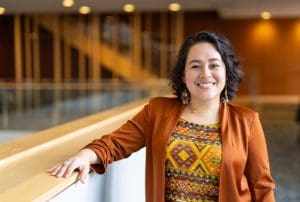 She graduated in May 2025, an achievement that marked both an ending and a beginning. “Through the Rotary Peace Fellowship, it was a great opportunity to pause, reflect, learn and unlearn so many things,” she says. That pause, she explains, allowed her to better understand the impact of her work. “The excitement of understanding the impact of my work as something that’s necessary and powerful has been so empowering.”
Paola’s path into peacebuilding took shape over years of working in development across Latin America, including formative time in Cusco, Peru, where her work centered on youth leadership and girls’ empowerment. Through her involvement with Visionaria Network, she helped establish a local team, Visionaria Peru, working closely with high school students and teachers. Together, they developed a curriculum within the civics course area that integrated leadership development through project based learning. Students envisioned and piloted initiatives aimed at social change in their communities, from water and sanitation projects to female leadership workshops co-hosted with local authorities.
This work also created space for deeper engagement with gender equality. Paola collaborated with both female and male teachers, inviting them to reflect on their own gender biases and the roles and norms they had inherited, many of which were being unintentionally reproduced in their classrooms. These reflections became an important step toward reshaping how young people experienced leadership, participation, and possibility.
Earlier in her career, she understood peace primarily through a humanitarian and diplomatic lens and did not initially see her development work as part of that landscape. It was during her time as a Rotary Peace Fellow that this perspective began to shift. She came to understand peace as something broader, embedded in everyday systems, relationships, and opportunities. Through this lens, she now sees her work in development as an active and meaningful contribution to peacebuilding.
Now, as a Founder’s Fellow with MBBI, she is focused on building bridges in both a practical and deeply relational sense. At the core of her fellowship is a commitment to reigniting relationships with professionals who previously participated in the International Peace Training Institute, many of whom have built strong foundations in mediation and peacebuilding. Ideating conjunctly with MBBI’s CEO, Prabha Sankaranarayan, she’s invested in exploring the expansive potential of diversity in mediation, making room for women, youth, indigenous and LGBTIQ+ (amongst others) peacebuilders, practitioners and mediators to share and guide..
Her work centers on connecting people, ideas, and opportunities, particularly across Latin America. “There are opportunities to connect the needs,” she explains, describing her role as one that helps align resources with communities and individuals ready to engage in meaningful work. Part of that effort involves continuing to support the initiatives alumni have already been leading by connecting them with opportunities on the ground and pairing them with seasoned mediators. In doing so, she is helping cultivate a space for peer learning, intergenerational richness, and interregional knowledge exchange. At the same time, she continues strengthening relationships within MBBI and contributing to a growing network of practitioners working on the ground.
She is especially drawn to the idea that “mediation skills are leadership skills,” a perspective she encountered through her work with mentors and colleagues. For Paola, peacebuilding is not just about resolving conflict but about cultivating the conditions for collaboration. This includes making resources more accessible and opening doors for regional partnerships that might not otherwise exist.
Her understanding of peace resists simple definitions. “It looks so different. It depends on the communities I’m working with, their stories, the need they have,” she says. Rather than imposing a fixed idea, she begins with an invitation. “It begins with inviting people to the conversation.” In her experience, lived realities shape how peace is imagined and practiced. “Lived experiences really nurture the way different communities conceive peace in their day to day.”
That approach requires humility, something she continues to navigate in her own journey. One of the most persistent challenges she faces is internal. “In many areas that require involvement, a big challenge is imposter syndrome,” she admits. The scale and potential impact of peacebuilding work can feel overwhelming. Still, she has learned to ground herself in patience. Trusting that even small interventions, a workshop, a conversation, a moment of connection, can have lasting effects has helped her stay committed.
When working across different cultural and political contexts, Paola emphasizes the importance of presence. “With a lot of curiosity and a lot of respect,” she says, describing how she approaches unfamiliar environments. “It is about being present and making room for that community, for that group, for that person.” She resists the urge to arrive with answers, instead focusing on openness. “Focus on curiosity and not certainty, an openness to combine knowledge and finding a balance that lets people make decisions for themselves.”
This mindset extends to her views on technology. She sees social media not as an abstract force, but as a human tool that reflects the intentions of its users. “We look at social media as its own thing, and more often than not, we tend to forget that there is a human behind it,” she says. While it offers powerful opportunities for connection, she believes it must be used thoughtfully. “We should use this as a tool and not let it run its own show.” For her, accountability and reflection are essential, especially as younger generations grow up immersed in digital spaces.
Despite the challenges, Paola finds meaning in small, transformative moments. Success, for her, is not measured in sweeping outcomes but in quiet realizations. “Aha moments are very important,” she says. “Success comes when I’m holding a conversation or facilitating a workshop, and people have their own aha moments.” Creating spaces where people feel safe enough to reflect, share, and shift their perspectives is, in her view, the heart of peacebuilding. This view became the core of her presentation “Creative ways for everyday peace” at the 22nd Annual Spring Conference “Stories of Peace: Centering Community for Collective Transformation” hosted by the DUKE-UNC Rotary Peace Center (May 2025). “Success for me is starting the conversation that leads to people finding their own aha moments.”
Building trust within communities is central to that process. Paola returns to two guiding principles: curiosity and authenticity. She is intentional about showing up honestly, even when that means acknowledging uncertainty. “I don’t have all the answers. I’m here to learn along with you,” she often tells participants. This openness helps create a balance between leading and listening. “Finding a balance between taking up space and also giving someone space,” she explains.
She is particularly inspired by the role of youth, women, and marginalized groups in this work. “They navigated a system that was never built for them, and they do it so well,” she says. Their resilience and creativity, she believes, offer valuable lessons for the broader field of peacebuilding. These communities bring perspectives that challenge conventional approaches and expand what is possible.
Over time, her own understanding of conflict has evolved. Growing up and working in Latin America, she has become more aware of how dominant narratives around peace are often shaped by Western frameworks. “My understanding of conflict and peace is shaped from a Western perspective,” she reflects. Acknowledging that influence has led her to be more intentional about how she engages in this work. “Diversity is enriching,” she says, emphasizing the importance of multiple ways of knowing and experiencing the world. What gives her hope is the gradual opening of spaces for dialogue and exchange. “We’re slowly but surely understanding that there is a lot of wisdom in different pockets of experience and life,” she says. The shift away from singular narratives toward more inclusive conversations signals progress, even if it is incremental.
For now, Paola is not rushing toward the next milestone. “I feel that I am living in my next right now,” she says with quiet confidence. Her focus is on staying present, continuing to learn, and deepening her practice. She is particularly interested in exploring trauma informed approaches and how mediation can serve as a tool for transformation.
Looking ahead, what excites her most is the opportunity to keep connecting. To people, to ideas, and to the evolving possibilities of peacebuilding.
Article by Shamailah Islam, MBBI Writer