Dialogue, Trust, and the Work of Peacebuilding. Member Spotlight: Anne Sawyer
Anne Sawyer learned early that conflict was not something distant or abstract. Growing up in California in a family of lawyers, she was surrounded by disagreement, negotiation, and strong perspectives. As a child, she did not yet have the tools to make sense of those dynamics, but she felt their presence deeply. “Curiosity and fear of conflict was inhabiting anything I could see,” she recalls. Over time, that initial fear began to shift into something else. What started as discomfort evolved into a deeper curiosity, not just about individual disagreements, but about the systems that shape them.
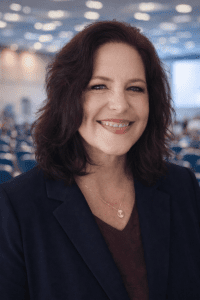 Her professional path did not begin in peacebuilding. Instead, it started in the legal world, where she worked first as a legal secretary, then as a paralegal, and eventually as a law firm administrator. For 15 to 20 years, she built a career grounded in structure, procedure, and the mechanics of legal conflict. But something about the process felt incomplete. The systems were designed to resolve disputes, yet they did not always create understanding.
A turning point came when she became connected with Pepperdine University through a private sector project. There, she was introduced to mediation. “I dove right into this new field of conflict resolution,” she says. What she found was not just a new career path, but a language for something she had been navigating her entire life. “In a way, I’ve been mediating my whole life.”
Anne went on to become deeply involved in the field, eventually serving as Executive Director of the Southern California Mediation Association (SCMA) and past president of Kids Managing Conflict, which is the foundation of SCMA. During that time, her work continued to evolve beyond formal roles. “From there I connected with Days of Dialogue and Avis Ridley Thomas to facilitate civic dialogues as part of my volunteer practice,” she says. Her experience expanded across mediation, facilitation, and leadership, always circling back to one core idea: conflict is not something to avoid, but something to engage with thoughtfully.
Her approach was further shaped by personal reflection. “I wasn’t given the skillsets as a child on how to deal with conflict,” she explains. That realization became a driving force in her work. Rather than focusing solely on resolving disputes, she began to emphasize the importance of creating environments where people feel safe enough to have honest conversations. For Anne, peacebuilding is about the conditions that make understanding possible. “Peace is the presence of trust, dignity and the ability to communicate.”
Today, her work sits at the intersection of leadership, dialogue, and mediation. After years of traditional mediation practice, her career shifted again during the COVID-19 pandemic. Like many in her field, she found the isolation and intensity of that period challenging. At the same time, the murder of George Floyd sparked a wave of public dialogue and community engagement. Anne’s connection to this work, however, began much earlier. “I was involved with Days and INVLA at the beginning of my mediation career,” she explains. When the pandemic hit, that involvement deepened. “It accelerated and I began consulting Days in 2020 when we needed to transition the dialogue process online.”
What followed was an intense period of adaptation and growth. “I moderated over 200 virtual dialogues in 2020–2021 and that has become just another pathway to the process,” she says. That period reinforced her belief that structured dialogue spaces are essential, especially in moments of crisis. It also pushed her to think more broadly about systems and scale. She began exploring how technology, including AI, could intersect with conflict resolution, and how large-scale issues like homelessness could be approached through dialogue and systems thinking.
Her current work reflects that evolution. She now runs a consultancy practice focused on leadership and facilitation, and recently launched a new initiative called the Affinity Alliance. The passion project of hers aims to build a community for facilitators, mediators, and leaders, offering resources and shared spaces for those doing this work. At its core is a belief that peacebuilding cannot happen in isolation. It requires networks, collaboration, and sustained support.
The day-to-day reality of her work is anything but predictable. “No two days look the same for me,” she says. The challenges shift constantly, requiring flexibility and responsiveness. “I’ve learned to pivot.” Whether she is facilitating a dialogue, designing a process, or advising leaders, the ability to adapt is essential. As her work continues to evolve, she is also thinking more expansively about its reach. “I’m increasingly focused on how large-scale systems, like homelessness or emerging technologies, require new forms of dialogue and coordination,” she explains.
At the same time, she is candid about the emotional demands of the work. “We are all challenged right now,” she says, referring to peacebuilders and facilitators working in increasingly complex environments. Supporting people through vulnerability requires care, structure, and intention. “Taking care of humans is hard work.” For Anne, this makes collaboration not just beneficial, but necessary.
Her approach to facilitation is deliberately open. Rather than imposing rigid structures, she emphasizes the importance of showing up and listening. “You just have to plan to show up and listen and give them the space to be heard,” she explains. This means approaching conversations without predetermined outcomes and creating space for diverse voices. “Anyone can come and have this conversation.”
That inclusivity is central to how she understands effective peacebuilding. “They’re imperative and valuable, we need diversity of experiences,” she says, referring to youth, women, and marginalized groups. Without that diversity, dialogue remains incomplete. “You can’t have good dialogue or peacebuilding conversation unless you have all voices.”
Her definition of success is not tied to resolution in the traditional sense. Instead, it is rooted in moments of transformation, however small. “I love when I see the light switch on for people,” she says. These moments, when someone reaches a new understanding simply by listening, are what sustain her work.
Measuring impact, however, requires a broader lens. Anne looks beyond individual conversations to the larger context. “Watching the news and listening to what is happening, local dynamics, histories, politics,” she explains. Each community is different, and understanding those differences is essential. “No two communities are the same.” For her, it is not just about the people in the room, but the frameworks that shape their interactions. Technology, including social media and AI, plays an increasing role in that landscape, amplifying voices while also complicating dialogue. Staying connected to facilitators on the ground helps ensure those realities are not overlooked.
Trust, in her experience, is built through consistency and presence. “Be in it to be honest,” she says. It is not about having the right answers, but about showing up with a genuine commitment to listen. “Sometimes the most trust building thing you can do is acknowledge complexity.”
This perspective extends to the relationship between peacebuilding and politics. In a time of deep polarization, Anne sees dialogue as both more difficult and more necessary. “We’re all struggling with that,” she admits. Yet she remains firm in her belief that caring about others should not be partisan. “Our unity and biggest strength is being able to have dialogue.” Even when conversations are uncomfortable, they are essential for any meaningful shift.
Over time, her perspective has shifted in ways she could not have anticipated. “When I first got into this I was going to be a problem solver,” she says. But experience gradually reshaped that mindset. “After a while I realized, I’m not looking for resolution for everything.” Instead, she came to see the deeper value in the process itself, in creating space for understanding rather than forcing outcomes. “My work now focuses on helping leaders and systems navigate complexity, not just conflict,” she explains. At her core, this approach is rooted in something more personal. She reflects, “I am a community builder at heart and that is what drives and sustains me.”
Looking ahead, she finds hope in the growing recognition of these skills. “As we continue to invest in these skills, I hope that we continue to see peacebuilding as an essential piece of how we lead, govern or how we show up in communities every day,” she says. Her vision is one where peacebuilding is not a specialized field, but something woven into everyday life.
If she could change one thing globally, it would be how people respond to conflict. Too often, she believes, the instinct is to withdraw. Instead, she advocates for connection. “We need people to stay together even if it feels uncomfortable,” she says. “Don’t avoid conflict but walk through it.”
That belief carries into her future plans. Through the Affinity Alliance and her broader work, she hopes to continue building capacity for difficult conversations. The goal is not perfection, but persistence. “That we continue to build the capacity to stay in the conversation even when it is hard.”
For Anne Sawyer, peace is not a distant ideal. It is something built, moment by moment, in the spaces where people choose to listen, to stay, and to try again.
Article by Shamailah Islam, MBBI Writer